
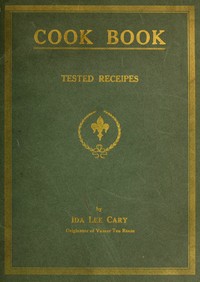
Cook book of tested receipes by Ida Lee Cary
I picked up Ida Lee Cary's 'Cook Book of Tested Recipes' expecting a simple historical artifact. What I found was a surprisingly intimate and practical guide that completely pulled me into the world of a 1914 American kitchen. This isn't a fancy chef's manual; it's a working document, compiled from recipes that were truly used and trusted.
The Story
There's no fictional plot here, but there is a narrative. The book is a collection of recipes organized by category: breads, cakes, meats, preserves, and even a section on 'Invalid Cookery' for the sick. Each recipe is brief, often just a list of ingredients and a few lines of instruction, assuming a base level of kitchen knowledge. You'll find 'Ice Cream' made with a custard base, 'Green Tomato Pickles,' and 'Scotch Shortbread.' The real story, however, is in the details. Recipes for 'Economical Cake' and 'War Cake'—made without eggs, milk, or butter—tell a silent story of scarcity and resilience. The 'tested' in the title is a promise: these aren't fancy ideas, they're methods that worked for real people.
Why You Should Read It
This book is a quiet revelation. Reading it feels less like studying history and more like overhearing a conversation between great-grandmothers. The lack of personal detail about Ida Lee Cary is actually its strength. It turns the book into a community project, a shared ledger of culinary wisdom. You start to imagine the women who contributed these 'tested' recipes, swapping them after church or over a garden fence. The recipes are a direct challenge to our modern cooking sensibilities—they are forgiving, adaptable, and rooted in making do with what you have. It made me appreciate the ingenuity of home cooks in an era without food processors or instant thermometers. It's a humbling and inspiring look at the foundation of home cooking.
Final Verdict
This book is perfect for history lovers who enjoy social history, foodies curious about culinary roots, and anyone who has ever looked at an old family recipe card and wondered about the story behind it. It's not for someone looking for glossy food photography or precise, modern recipes. But if you want to connect with the tangible, daily life of the past and maybe even try your hand at a century-old gingerbread, Ida Lee Cary's tested recipes are waiting for you. It's a small, profound tribute to the invisible labor that has always kept homes and families together.
Steven Flores
1 year agoEssential reading for students of this field.
Ava Williams
4 months agoFinally found time to read this!
Brian Walker
1 year agoI had low expectations initially, however it creates a vivid world that you simply do not want to leave. Worth every second.
Edward Brown
1 year agoHigh quality edition, very readable.






Daniel Taylor
1 year agoSurprisingly enough, the character development leaves a lasting impact. Don't hesitate to start reading.