
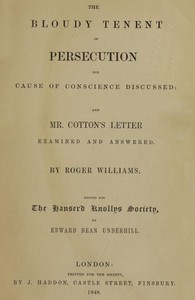
The Bloudy Tenent of Persecution for Cause of Conscience Discussed and Mr.…
Let's be clear: this isn't a novel. There's no plot in the traditional sense. The Bloudy Tenent is a full-throated, point-by-point argument against the government punishing people for their religious beliefs.
The Story
The book is framed as a dialogue between two characters: Truth and Peace. They're discussing a real-world debate that was raging in England and the American colonies. The core question was simple but explosive: Does the state have the right to enforce religious uniformity? Roger Williams, who had been kicked out of Massachusetts for his own unorthodox views, answers with a resounding 'no.' Through Truth and Peace, he dismantles every argument used to justify persecution. He says forcing belief is impossible—you can't beat an idea into someone's soul—and that trying to do so only leads to hypocrisy, violence, and the corruption of true religion. The 'story' is the relentless, logical journey to that conclusion.
Why You Should Read It
I picked this up expecting a dry historical document. What I found was a voice of raw, principled fury that feels urgent even now. Williams doesn't just make a political case; he makes a moral and spiritual one. His passion is palpable. He writes about the 'bloudy tenent' (bloody principle) of persecution as a poison that destroys societies. Reading his arguments, you realize how foundational this struggle was. It’s humbling to see these ideas—so familiar to us now—being fought for with such clarity and courage at a time when they could get you killed. It connects the dots from the 17th century to our modern debates about freedom in a powerful way.
Final Verdict
This book is a commitment. The 17th-century prose takes some getting used to. But it’s worth the effort. Perfect for history buffs, political philosophy nerds, or anyone who loves seeing a radical idea born. It’s not a casual beach read; it’s more like visiting the intellectual battlefield where religious freedom was won. If you want to understand the deep roots of American ideals about liberty, start here. You'll come away with a newfound respect for Roger Williams, not just as a historical figure, but as a brilliant, fearless thinker whose work still matters.









Emma Wilson
7 months agoAfter finishing this book, the character development leaves a lasting impact. Exceeded all my expectations.