
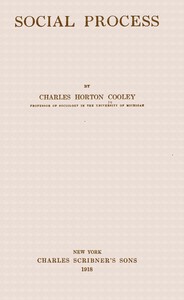
Social process by Charles Horton Cooley
Let's be clear: Social Process isn't a novel. You won't find a plot with a hero and a villain. Instead, the "story" is the story of human connection itself. Charles Horton Cooley, writing in the early 1900s, sets out to explain how society functions. He throws out the idea of society as a separate, rigid structure that exists above us. Instead, he paints a picture of society as something that is constantly being made and remade through our daily lives.
The Story
The core of Cooley's argument is that society is an organic process, like a growing plant or a flowing river. It's built from the ground up. He introduces his famous idea of the "looking-glass self": we form our identity based on how we imagine others see us. From that simple, personal starting point, he shows how all larger institutions—families, schools, economic systems—are just more complex patterns of these same interpersonal connections. The "plot" follows this logic from the individual mind all the way out to the broad sweep of social change, arguing that progress and conflict are natural parts of this ongoing human conversation.
Why You Should Read It
I picked this up thinking it would be a dry history lesson, but I was wrong. Cooley's writing has a quiet, persuasive clarity. Reading him feels like having a brilliant, patient friend explain the world. His ideas are everywhere now—you've probably heard of the "looking-glass self"—but going to the source is rewarding. It gives you a framework to understand everything from why fashion trends catch on to how political movements gain power. It made me feel less like a passive member of society and more like an active participant in a giant, collaborative project. In an age of online echo chambers and polarized debates, his vision of society as a continuous, communicative process feels incredibly relevant and even hopeful.
Final Verdict
This book is perfect for curious minds who enjoy big ideas. If you like authors like Malcolm Gladwell or Yuval Noah Harari who connect dots across disciplines, you'll appreciate Cooley's foundational thinking. It's also great for anyone in fields like teaching, marketing, or community work, where understanding human networks is key. It's not a light beach read, but it's far more accessible than its academic pedigree suggests. Think of it as the user manual for how human groups function, written by one of the original designers. Give it a shot—it might just change how you see your place in the world.
Carol Allen
1 year agoTo be perfectly clear, the depth of research presented here is truly commendable. Thanks for sharing this review.
Michelle Walker
1 year agoAmazing book.
Karen Davis
1 year agoI was skeptical at first, but it manages to explain difficult concepts in plain English. Absolutely essential reading.








Ashley Gonzalez
9 months agoThis book was worth my time since the narrative structure is incredibly compelling. Worth every second.